

Filipino political scientist offers views for improved PH-Sino relations
Interview for the PH-China Talks by Ms. Cathy Cruz
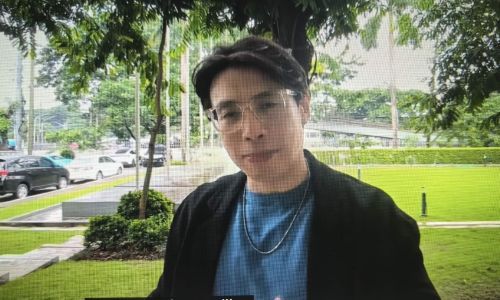
AN Assistant Professor on International Relations at the University of the Philippines (UP-Diliman) Political Science Department who also finished his Doctorate on Political Science in Beijing, has called for greater mutual trust and deeper understanding of China’s foreign policy to guide the Philippines in restoring its former warm diplomatic relations with the People’s Republic of China.
Dr. Enrico V. Gloria, also a graduate of the well-known Tsinghua University, also called for a return to the country’s independent foreign policy as “essential pillars” for maintaining peace and stability in Philippines–China relations amid continuing tensions in the South China Sea.
His remarks came during a wide-ranging interview on bilateral relations, regional security, and the country’s foreign policy priorities by ‘PH-China Talks.’
Gloria identified the lack of mutual trust between Manila and Beijing as the greatest challenge facing the two countries today.
He said trust begins with consistency in foreign policy and diplomacy, noting that domestic political changes in the Philippines often influence its external policies and create uncertainty in bilateral relations.
He also argued that the widespread perception that China intends to occupy the Philippines is a misconception that continues to hinder constructive engagement.
Reflecting on his academic journey, Gloria explained that he decided to study in China during the height of the 2013 Scarborough Shoal dispute because few Filipino scholars at the time specializes in Chinese foreign policy and its growing global influence. He underscored that genuine understanding of another country requires studying its language, culture and society firsthand, arguing that sound policymaking must be built on accurate knowledge rather than assumptions.
Addressing the West Philippine Sea dispute, Gloria stressed that the Philippines should continue to assert its sovereignty and protect its national interests while avoiding unnecessary confrontation.
According to him, asserting sovereign rights and maintaining peaceful relations with other claimant states are not mutually exclusive and can be pursued simultaneously through diplomacy.
He also emphasized the importance of maintaining an independent foreign policy, saying the Philippines, as a middle power and ASEAN member, must carefully balance its relations with both China and the United States rather than becoming overly dependent on either side.
Gloria challenged what he described as the prevailing “China threat” narrative, arguing that while China’s rise presents significant geopolitical challenges, it should not automatically be interpreted as a direct military threat or evidence of ambitions to dominate the region.
Instead, he said policymakers and the public should first understand China’s development priorities and strategic thinking before drawing conclusions about its intentions.
Drawing from his seven years of studying and living in China, Gloria said he never personally experienced racial hostility because he was Filipino despite ongoing territorial disputes.
“Peace is still the main objective of both nations,” he said, urging both sides to begin their dialogue from that shared objective rather than assuming conflict is inevitable.
Reflecting on his academic journey, Gloria explained that he decided to study in China during the height of the 2013 Scarborough Shoal dispute because few Filipino scholars at the time specializes in Chinese foreign policy and its growing global influence.
He underscored that genuine understanding of another country requires studying its language, culture and society firsthand, arguing that sound policymaking must be built on accurate knowledge rather than assumptions.
He further encouraged Filipinos to examine China’s foreign policy discourse, saying that understanding the country’s history, political thinking and worldview provides a more accurate picture of its international behavior than focusing solely on its actions.
He added that expanding academic and people-to-people exchanges would help reduce misunderstandings and improve bilateral relations.
Gloria also urged greater recognition of China’s humanitarian assistance to the Philippines, particularly its disaster relief efforts.
He noted that such contributions should be acknowledged as part of the broader relationship between the two countries, adding that the West Philippine Sea dispute represents only a relatively recent chapter in the centuries-long history of Philippines–China relations.
On the broader direction of Philippine foreign policy, Gloria said national interest should remain its primary guiding principle. He argued that foreign policy should ultimately promote the welfare, development and security of the Filipino people while remaining peaceful and non-aggressive in its engagement with the international community.
Concluding the interview, Gloria described China as a prosperous and highly developed country from which the Philippines could learn valuable lessons, particularly in poverty reduction, technological advancement and long-term economic development.
He said the Philippines would benefit from studying China’s development experience as it continues to pursue more equitable and sustainable national growth (Cathy Cruz).

Comments are closed.