

PH BUSINESS REJECTS TEODORO CALL TO ‘DECOUPLE’ FROM CHINA
Consider, advance PH interests first, group tells government
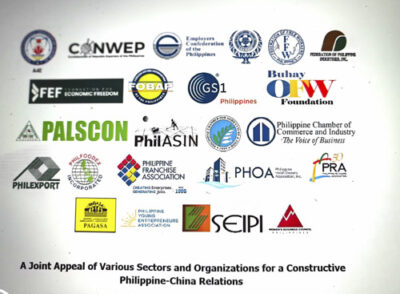
TWENT THREE of the country’s biggest business organizations rejected the call of Defense Secretary Gilberto ‘Gibo’ Teodoro to join his anti-China campaign and his call for them to ‘decouple’ from China by looking for other sources of supply for their businesses.
In a statement, the group said they appealed to the Marcos administration for “sobriety, restraint, statesmanship, and renewed diplomatic engagement” as the verbal war between some government officials and the Chinese Embassy continues to rage.
The group said they are making their position known “for economic stability, responsible diplomacy, stronger Philippine industries, decent work and a more prosperous future for the Filipino people.”
“Amid global uncertainties, we urge measured diplomacy that advances Philippine interests.
“All parties should avoid inflammatory rhetoric, public recriminations, and social media exchanges that could further strain bilateral relations.
“Diplomacy is best pursued through established channels, coordinated institutions, informed to dialogue, mutual respect, and a clear understanding of national interests,” the statement reads.
The group also subtly attacked the administration’s current foreign policy, noting that what the country needs is a foreign policy that is “principled yet pragmatic, resolute yet diplomatic, and anchored in protecting sovereignty, economic security, and long-term development.”
The statement also reminded that the economies of China and the Philippines “are deeply interconnected through trade, manufacturing, construction, infrastructure, agriculture, retail, energy, electric vehicles, solar panels, and other vital sectors.”
“China supplies essential goods, industrial inputs, machinery, electronics, strategic raw materials, and renewable-energy technologies that support businesses, employment, consumers, and the clean-energy transition.”
Amidst this reality, the group argued that following calls to decouple from China would hardly affect China as its exports to the Philippines represents less than 1 percent (0.3 to 0.5) of China’s total global merchandize trade.
On the other hand, the government’s own data showed that in the first half of 2026, China and Hongkong constitute the Philippines’ largest trading partner, accounting for nearly 30 percent (26.3 percent of exports, 27 percent to 29.5 percent imports) of our total international trade.
“Because trade with China represents a far greater share of Philippine external trade than the Philippine market represents of China’s global trade, we must practice careful economic statecraft while pursuing strategic diversification, stronger domestic industries, local assembly and manufacturing, and sound diplomacy,” the statement reminded the government.
The group also stressed that the country “benefits significantly” from overseas Filipino workers in China, Hongkong and Macao. “Their remittances support millions of families, strengthen consumption, fund education, housing, healthcare, and small businesses, and contribute to foreign exchange earnings and economic resilience.
“These people-to-people ties further underscore the need for stable, respectful relations,” they said, as they recommended the following;
• First, exercise sobriety and restraint. Use measured language and avoid personal exchanges or public statements that heighten tensions without advancing the national interest.
- Second, strengthen a centralized, coherent, and consistent foreign policy. Diplomatic positions should be articulated by designated authorities through coordinated institutions and established channels.
- Third, uphold sovereignty while preserving economic cooperation. The Philippines must defend its sovereign rights under international law while maintaining dialogue and practical cooperation in trade, investment, tourism, energy security, electric mobility, solar deployment, and other mutual interests.
- Fourth, prioritize trade, investment and creation of decent work. Both governments should pursue market access, resilient supply chains, technology transfer, local production, clean energy generation, and productive investment, consistent with the principles of business and human rights, benefitting Filipino enterprises, farmers, fisherfolks, manufacturers, exporters, workers, consumers and communities.
- Fifth, pursue strategic diversification alongside constructive engagement. Broader trading relationships, stronger domestic capacity, local assembly and manufacturing, and alternative sources of critical supplies should complement— not replace—diplomacy.
- Sixth, promote mutual respect and responsible communication. Disagreements should be addressed through quiet diplomacy, sustained dialogue, and appropriate official mechanisms rather than public exchanges that harden positions.
“The ultimate measure of diplomacy is whether it protects national interests, prevents avoidable conflict, creates opportunities, and improves the lives of our people—not who prevails in a public exchange,” the group went further.
“For the Philippines, the path forward must be one of sobriety, strategic clarity, economic pragmatism, and constructive engagement with China and the wider international community,” the statement stressed.
Signing the statement are the leaders from the following organizations: Asian Association of Academic Administrators and Educators Inc. (A4E); Confederation of Wearable Exporters of the Philippines (CONWEP); Employers Confederation of the Philippines (ECOP); Foundation for Economic Freedom (FEF); Federation of Filipino Chinese Chambers of Commerce and Industry, Inc. (FFCCCII);
Federation of Free Workers (FFW); Federation of Philippine Industries, Inc. (FPI); Foreign Buyers Association of the Philippines (FOBAP); GS1 Philippines; OFW Foundation; Philippine Amalgamated Supermarkets Association; Philippine Association of Legitimate Service Contractors (PALSCON);
Philippine Association of Salt Industry Networks Inc. (PhilASIN); Philippine Chamber of Agriculture and Food, Inc. (PCAFI); Philippine Chamber of Commerce and Industry (PCCI); Philippine Exporters Confederation, Inc. (PHILEXPORT); Philippine Food Processors and Exporters Organization, Inc. (PHILFOODEX); Philippine Franchise Association (PFA);
Philippine Hotel Owners Association, Inc. (PHOA); Philippine Retailers Association (PRA); Philippine Young Entrepreneurs Association (PYEA); Semiconductor and Electronic Industries in the Philippines Inc. (SEIPI) and, Women’s Business Council Philippines (WomenBiz).

Comments are closed.