

IN WHOSE FAVOR IS THE LATEST PH-US DEALS?
‘Déjà vu’ as PH returns to the era of the Bell Trade Act
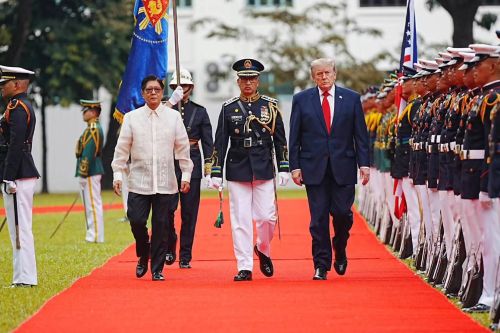
THE Philippine government is continuing with its determined march to strengthen the country’s neo-colonial ties with its former oppressor, American Imperialism, results of the recent stopover in Manila of US President Donald Trump last November 17, showed.
While the government continues to dilly-dally and cherry-pick which details of its fresh commitments to the Americans it will share with Filipinos, the White House has already disclosed them. It did so on November 18, the day Trump left for Shenzhen, China, for the 33rd Asia-Pacific Economic Cooperation (APEC) Summit.
Trump passed by Manila for the 49th ASEAN Summit that the Philippines hosted and to confirm the commercial and military deals that was reached before his arrival.
He then flew to Shenzhen for his historic ‘Trilateral Meeting’ with Chinese President Xi Jinping and Russian President Vladimir Putin that went smoothly the following day.
All about American jobs and businesses
The White House Factsheet, ‘President Donald Trump Secures Historic Economic Deals For American Workers and Strengthen America’s Leadership in Asia,’ made it clear that the deals he oversaw in Manila with President Marcos Jr. is not about supporting Philippine interests but about promoting American jobs and businesses while ensuring that the country remains enmeshed in America’s aggressive policy against China.
Continued Philippine dependency on the United States on behalf of American jobs and farmers was made clear in the November 18 statement: “…(T)he two leaders announced landmark deals that will strengthen the U.S.-Philippine Alliance and support American companies and workers.
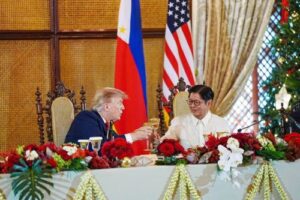
“The leaders also committed to eliminate the U.S. trade deficit with the Philippines through increased Philippine imports of American energy and agriculture products, which will support the jobs of tens of thousands of American engineers, technicians, and farmers.”
Trump, Rubio confirmation
At the White House presser after his return from the APEC Summit and his meeting with Xi and Putin, President Trump clarified that the “framework deal” with the Philippines means the Philippines would buy American products— fuel and agricultural products— “100 percent” and without any tariff.
“We are talking about billions and billions of dollars of farm products they (Philippines) are going to buy from us,” Trump said.
With Trump’s clarification, this would mean that the nominal Philippine tariff for ‘MFN’ (most favored nations) of between 5.5 percent and 6 percent for non-agricultural and agricultural products, respectively, would be brought down to zero.
The trade relationship now harks back to the 1946 Bell Trade Act wherein US goods can enter the Philippines, tax-free, but minus the Act’s ‘parity rights’ provision that gave US companies and citizens equal rights with Filipinos to own, exploit and develop the country’s natural resources and operate public utilities.
On the other hand, the Philippines would still negotiate with the United States if it can get the same zero-tariff arrangement as it is still saddled with a 12.5 percent tariff for Philippine goods entering the United States.
The trade relationship now harks back to the 1946 Bell Trade Act wherein US goods can enter the Philippines, tax-free, but minus the Act’s ‘parity rights’ provision that gave US companies and citizens equal rights with Filipinos to own, exploit and develop the country’s natural resources and operate public utilities.
The Philippines was forced under this unequal trade relationship as it was just recovering from the devastation of World War 2 and its then president, Manuel Roxas, has been selected by the Americans to lead the country during the immediate post war period.
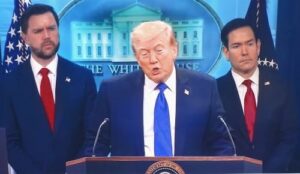
For his part, Marco Antonio Rubio, both Secretary of State and National Security Adviser, reasoned that the already unequal US-Philippines defense relations should now be reflected in the commercial aspect as well.
“The United States is the primary defense provider for the Philippines. Our economic relations with them should reflect that.
“If we are the primary defense provider, then what we do from a commercial standpoint should reflect that commitment that we have made and the President personally negotiated an agreement on reciprocal trade that we think is highly beneficial and fair but highly beneficial to American workers and the American economy,” Rubio explained further.
Breaking down the money trail
The November 18 White House statement bared that the biggest deal amount of $12B is for the commercial deal between Philippine Airlines (PAL) and Boeing/GE Aerospace for the delivery of 20 Boeing 787 jets directly benefitting 47,000 US jobs.
Meanwhile, the defense component, $2B in fresh foreign military financing (FMF) loan package, is about supporting “supporting 7,000 American jobs.”
The FMF would not only ensure that the Philippines remains tightly enmeshed in the US’ aggressive containment policy against China. It would also serve the Trump administration’s 2026 ‘National Security Strategy’ (2026 NSS) of ‘security burden-sharing.’
Under it, satellite states such as Europe, Japan and the Philippines are pushed to raise their defense spending to as much as 5 percent of their gross domestic product—at the expense of education, health, social welfare and other public services—and for which Defense Secretary Gilberto Teodoro has shown much enthusiasm in expressing his support.
The $2B military loan to the Philippines would also result to the Americans having a ‘free ride’ in further developing their 9 military bases in the country even as the Philippines risks accusation that it is becoming the destabilizing force in the region.
The briefer also did not mention anything about allocating money for ‘HDR’ (human disaster response) activities that both sides claim is the main purpose of expanding US military presence in the country.
“The United States will utilize $400 million in FMF for the Philippine military to expand its operational reach and deterrence capabilities in the South China Sea, including long-range fires, command and control, critical infrastructure, and multi-domain drones, supporting 1,500 American jobs,” the statement reads.
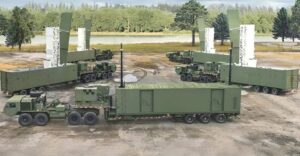
In simple language, this is a thin veil to mean more US troops being stationed for longer times in the Philippines, increased port visits of US warships and stationing of more US offensive missiles such as the ‘Typhoon Missile Battery System,’ the stationing of which in Northern Luzon since May 2024 has already drawn warning not only from China (Pinoy Exposé, December 7, 2024) but much earlier, from Russia (Pinoy Exposé, July 1, 2024).
Surrendering sovereignty in cyberspace
Even in the area of data storage and artificial intelligence, the Philippines has also agreed to entrust to the Americans its last vestige of sovereignty in cyberspace.
“The United States and the Philippines agreed to partner on supply the Philippines’ sovereign cloud infrastructure with trusted U.S. Super Intelligence technology through the United States’ SI Exports Program,” the White House announced.
The same agreement—surrendering Philippine sovereignty to US tech providers notorious for having ‘backdoors’ in their systems for US spying activities—would apply to the Department of National Defense (DND) for “SI-enabled mission support” while further expanding U.S.-Philippine defense cooperation and improved interoperability.
“The Philippine DND committed to work with trusted U.S. technology providers on a $63 million initiative to modernize its defense cloud infrastructure for SI use cases, supporting over 200 American jobs,” the statement bared further.
Philippine subservience to America also extends to the area of nuclear energy as the Marcos administration opted out from accessing the much cheaper and latest in nuclear power technology presently dominated by Russia and China.
“The United States and the Philippines announced exploration of an intergovernmental agreement on civil-nuclear technology which would open opportunities for U.S. nuclear companies, support American jobs, and generate gigawatts of energy for the Philippines.
“This marks the first U.S. civil-nuclear intergovernmental agreement with an Indo-Pacific partner,” the statement announced proudly.
Batanes as frontline against China
Meanwhile, a new, $40M new fuel storage depot to be constructed at Subic Bay is intended to “support U.S. military and commercial operations” and not the country’s domestic energy needs.
The statement also bared America’s plan to turn Basco Batanes as the frontline on its planned war against China through Taiwan. Batanes is less than 200 kilometers from the southernmost point of Taiwan where US installed missiles can directly target both Taiwan and mainland China.
“The United States and the Philippines announced that the Philippines will modernize its Basco Airport to improve U.S.-Philippine operational access, disaster response, and commercial supply chains in the Philippines’ northernmost islands,” the statement concluded.

Comments are closed.