

2016 ARBITRATION: BETRAYAL OF PH TERRITORIAL LEGACIES
By: Adolfo 'Ka Ado' Paglinawan, VP, Asian Century Philippines Strategic Studies Institute
(Editor’s Note: This is the statement issued by the Asian Century Philippines Strategic Studies Institute (ACPSSI) last July 11, a day before the commemoration of the July 12, 2016 ‘Arbitral Ruling’ of a 5-man international Ad-hoc Committee with the Permanent Court of Arbitration (PCA) at The Hague serving as the venue and registry for the suit that the Philippines paid for. We are reprinting it to help in the education of the Filipinos on the issue and with ACPSSI’s permission).
THE 2016 SCS Arbitral ruling was and is a continuing unmitigated disaster for the Philippines’ territorial sovereignty that we see manifesting in the following:
-
The ruling limits what are historic titles we inherited from the US through the 1898 Treaty of Paris and,
-
Our claim of the Kalayaan Island Group (KIG) as part of Philippine territory by virtue of Presidential Decree 1596.
In the first, the Philippines stand to lose 830,140 sq. kilometers of sovereign territory in order to gain a pyrrhic Exclusive Economic Zone (EEZ) beyond our western borders that will remain disputed by four other counterparties in perpetuity, unless dialogue and negotiations are conducted among all.
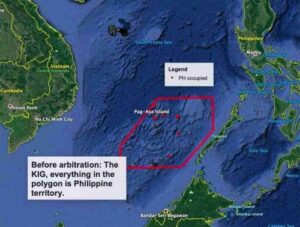
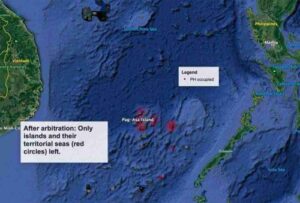
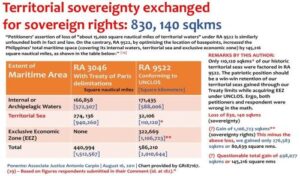 In the second case, the Arbitral ruling confirmed in Paragraph 574 that the Philippines’ Kalayaan Island Group claim does not meet the criteria for an archipelago under the UNCLOS as claimed in its entirety. In other words, the Philippines stands to lose the KIG polygonal territory of another 70,000 square kilometers.
Earlier in 2009, we conceded the case by reducing KIG to a fractured “regime of islands” under Republic Act 9522, but only with territorial waters for features with the high-tide elevations. (see attached map). We lost our claims for the remaining features that are low-tide elevations, as LTEs are not subject to sovereignty claims.
This is the sad consequence of the Filipino legalese mindset conforming our Republic 9522 “Baselines Law” to only one treaty, the United Nations Convention on the Laws of the Seas (UNCLOS) and ignoring the greater flexibility provided by diplomacy using the entirety of the international and customary laws.
 The Philippines hard-balled further, by incorporating RA9522 and codifying UNCLOS and the 2016 Arbitral Award, and including a fictitious “West Philippine Sea” into our Maritime Zones Act, championed by losing senator Francis Tolentino and signed by President Marcos Jr. on November 2024.
Arbitral Tribunal case proponents have argued: “China will comply.” But we seem to be going the opposite direction. Nine years have passed and China has fortified its assertion of sovereignty and actual control of the SCS areas disputed with the Philippines, in many cases effectively pushing out
Philippine challenges to its sovereign authority, in and around the disputed areas.
The 2016 Arbitral award has been a key “lawfare” and cognitive warfare strategy of the U.S. “Pivot to Asia” with its Filipino proxies, used to drive a wedge between China and the Philippines and create the “China bully” narrative to alienate China, isolate the Philippines from the ASEAN cooperation with China and violate ASEAN’s ZOPFAN and SEANFZT.
The Philippines has drawn subtle but telling admonitions from ASEAN luminaries such as ex-Singapore Prime Minister Lee Hsien Loong asking if the Philippines wants to be a “battleground” between the U.S. and China.
Malaysian PM Anwar Ibrahim has said while in Manila in 2023 that “US … military presence … should be avoided because this would then provoke and escalate tension.”
 The Arbitral Award is a key component of the “Atin Ito” myth used by US Filipino proxies to subvert and sabotage the effort to reach a “win-win” solution proposed since Premier Deng Xiaoping’s meet with President Cory Aquino and almost realized by President Duterte by his “60-40 oil and gas joint venture” with President Xi Jinping in 2017.
Alienating the Philippines from China caused the loss of $23-billion investments from China signed in January 2023. This was followed by the systematic dismantling of in-pipeline projects such as the multi-billion dollars projects, Luzon South Rail, Mindanao Circumferential rail, Subic-Clark rail projects, among many other priority projects bereft of funding.
Quotas have also been imposed on incoming visitors from China, dropping tourism inflows from the 1.9 million level already attained in 2019 to less than 400,000 last year, putting us even behind Cambodia.
The Philippines lost its national unity, peace and prosperity, as the U.S. and its Filipino proxies use the fairytale of the Arbitration Award to witch hunt and “China-tag” advocates of independent foreign policy and neutrality in international relations in order to advance America’s next proxy war in Asia and arms sales to the Philippines.
The Bongbong Marcos “pivot to the US” must be reversed and the primacy of the Philippine Constitution’s “independent foreign policy” as well as Article 18, Section 25 banning “foreign bases, troops, and facilities” must be restored.
The 20th Senate with its new majority of independent-minded, patriotic and foreign relations neutralist senators constitute a new hope for the Philippines to restore its sovereignty, independence and in putting the Arbitration Award in its proper perspective.

Comments are closed.