

CHINA OPTIMISTIC DESPITE TRUMP’S ‘TARIFF WAR’
World should reject America’s “law of the jungle where the strong preys on the weak”
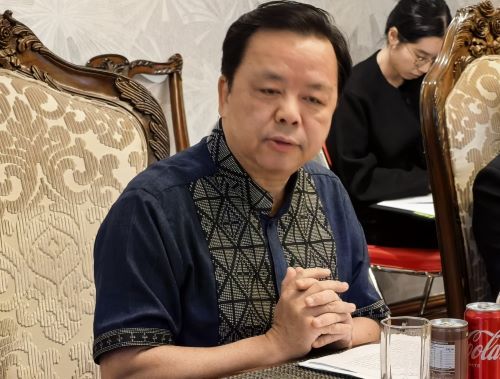
THE People’s Republic of China under President Xi Jinping remains optimistic its global, regional, and bilateral trade relationship would continue to see robust growth despite US President Donald Trump unleashing a global ‘Tariff War’ on April 2, that particularly targeted the Asian superpower.
The rates were supposed to take effect by April 9, with China getting an unprecedented tariff hike of 245 percent on some of its exports. Trump, however, announced a 90-days suspension of the tariff increases for other countries– except for China.
At a press conference at the Chinese Embassy Chancery in Forbes Park, Makati, last April 16, Ambassador Huang Xilian also presented China’s ‘White Paper’ approved by its State Council stating clearly its position on the issue as well as a summary of the meeting of the ‘Central Conference on Work Related to Neighboring Countries’ from April 8 to April 9, presided by President Xi.
Ambassador Huang assured all China’s trading partners that they can rely on China’s “supersize” market for their goods in the light of America’s ‘across-the-board’ tariff hikes on all countries it has been doing business with, including the Philippines.
Despite being a treaty ally and where the US claims its security commitment is “iron-clad,” America still imposed a 17 percent additional tariff on Philippine exports.
Amb. Huang noted the additional burden could make the Philippines lose $1.89 billion worth of exports to the US annually, citing a report from the Philippine Congress.
China, force for global stability
Pointing to China’s being the world’s biggest trader that contributed to 30 percent to the global GDP (gross domestic product) and as a major trading partner of 115 countries, Ambassador Huang contradicted the US’ claim that the punitive tariff it imposed on China would collapse its economy.
Contrary to the US narrative, Amb. Huang noted that in recent years, ASEAN has become China’s biggest trade partner, not the United States. Last year, he noted trade with ASEAN reached nearly $1 trillion.
He noted that in the first quarter, China’s own GDP was at 5.4 percent while its year-on-year foreign trade increased by 1.3 percent.
Ambassador Huang also assured that China would not go back on free trade and that its market would remain open to all its trading partners.
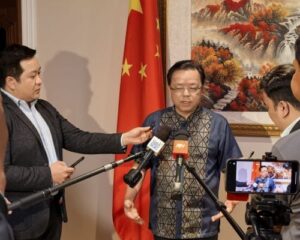
“China brings much needed stability to a volatile world; it provides certainty,” he said.
His assurance coincided with President Xi’s state visits starting on April 14, carrying the same message, to select ASEAN countries where China has maintained close economic partnership—Vietnam, Malaysia, and Cambodia.
Particularly Vietnam, China has again sent the clear message that it can do business and strike a balance in any relationship despite overlapping territorial claims.
Vietnam and China engaged in a bloody naval war in 1974 for control of the Paracel Islands and another bloody border war in 1979.
Despite this, China and Vietnam signed at least 45 agreements during President’s Xi’s visit, Western mainstream media confirmed.
Trade data provided by a report from Reuters on April 14, showed their bilateral trade is at its highest level. The data showed that Vietnam’s import from China reached $144 billion in 2024, compared to $58 billion in 2017.
On the other hand, after a return to normal relationship, America has become Vietnam’s biggest export market, rising from $46 billion in 2017 to $136 billion in 2024.
However, the 46 percent tariff imposed by the US on Vietnam is expected to hurt its economy when the rate starts to be imposed in July.
Call to protect free, global trade system
While doubling down on China’s position that it would not back down from Trump’s Trade War thru reciprocal escalation of tariff on imports from the United States, Ambassador Huang also reminded that all countries have benefitted from the ‘rules-based, market-led global trading system’ created under the guidance of the United States after the end of the Second World War.
“China brings much needed stability to a volatile world; it provides certainty.” — Amb. Huang
However, he pointed out that the US now wants to “destroy” the very system it created where it has “benefited” immensely.
Amb. Huang specifically called on ASEAN to “be on the right side of history” by standing together to oppose America’s “unilateralism,” “protectionism” and “economic bullying.”
He described America’s action as an “injustice” with the ‘Least Develop Countries’ (LDCs) to be the “hardest hit.”
He said China expects the rest of the world to join in “protecting the common interest of humanity” and prevent a return to the “law of the jungle where the strong preys on the weak.”
The global disruption unleashed by the US, Ambassador Huang pointed out, would negatively impact on the lives of “millions.”
“There is no winner in trade war, tariff war. It only leads to self-isolation,” he said.
The way forward
Amb. Huang added China also expects the Philippines to place itself at the “right side of history” by joining other countries and the ASEAN in opposing the US’ attempt at “private gain” thru “trade blackmail.”
“Compromise and concession do not protect sovereignty and wins respect. They only embolden the bully,” he reminded, referencing President Trump’s expectation for countries to seek compromise with the US in return to the lowering of their tariff rates.
As partners under the ASEAN-China Free Trade Agreement (FTA) and the ‘Regional Comprehensive Economic Partnership’ (RCEP), Ambassador Huang said it is to everyone’s interest to “work together to mitigate the impact of US tariff, jointly safeguard multilateral system with the ‘WTO’ (World Trade Organization) at the center.”
He also dismissed the erroneous claim that with China out of the US market, it intends to “flood” the ASEAN market with its exports.
Ambassador Huang noted that while trade imbalance is always present, the way forward for ASEAN members, the Philippines included, is to increase their market shares in China.
He pointed to the annual ‘China International Import and Export’ (CIIE) Exhibition in Shanghai where all countries are welcome to offer their goods and services to China.
During last year’s CIIE, the Philippines managed to generate $1.6 billion in export sales.

Comments are closed.