

PBBM TELLS PH SOLDIERS: ‘BE READY TO DIE FOR TAIWAN’
‘Refrain from playing with fire,’ China urges President Marcos Jr.
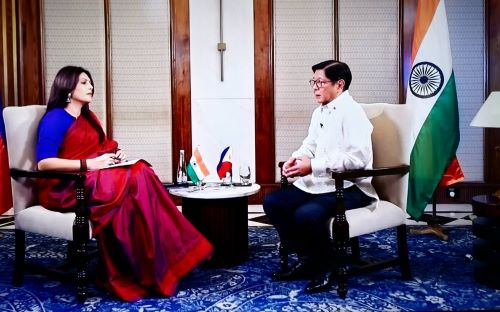
IN A dangerous turn of events, Philippine President Ferdinand Marcos Jr., dropped the country’s neutrality and independent foreign policy enshrined in the Constitution, basically telling Filipino soldiers to be ready to die for the sake of separatist elements in China’s island province of Taiwan.
In an interview last August 6 during his 5-days state visit to India, Marcos completely dropped the country’s ‘One China Policy’ by claiming “there is no way” the Philippines can avoid being at war with China should conflict between China and the United States escalated into actual war over Taiwan.
“To be very practical about it, if there is confrontation over Taiwan between China and the United States, there is no way that the Philippines can stay out of it simply because of our physical geographic location.
“And so if you think about it, if there is an all-out war, then we will be drawn into it. And I assure you with the greatest hesitation, but again, we will have to defend our territory and our sovereignty,” Marcos said.
He also reasoned that aside from the close geographical location between Taiwan and the Philippines, there is also a need to evacuate the more than 200,000 Filipinos presently working and living in Taiwan.
The President did not elaborate, however, how the country’s national interests are now linked with the internal affairs between China and Taiwan and where Filipino soldiers are now expected to die.
The One China Policy has been the cornerstone of the country’s foreign policy in relation to China and by the rest of the world, including the United States. This global recognition is anchored on the decision of the United Nations General Assembly (UNGA) on October 25, 1971, under Resolution 2758.
Nor did he explain how the Filipinos in Taiwan can be safely evacuated while the Philippines is actively participating in the US aggression against China.
The ‘One China Policy’
The One China Policy has been the cornerstone of the country’s foreign policy in relation to China and by the rest of the world, including the United States.
This global recognition is anchored on the decision of the United Nations General Assembly (UNGA) on October 25, 1971, under Resolution 2758.
UNGA Resolution 2758 recognized the People’s Republic of China as “the only legitimate representative of China to the United Nations,” thus ending Taiwan’s ambition to be recognized as a separate state (Republic of China) representing the Chinese people.
Resolution 2758 overturned Resolution 1668 tabled in 1961 by the United States and its vassal states such as Australia and Japan that turned the question of China’s representation at the UNGA into an Important Question’ (IQ).
Resolution 1668 aims to make it difficult for China to gain recognition thru the three-fourth of members vote rule on IQ issues brought before the UNGA.
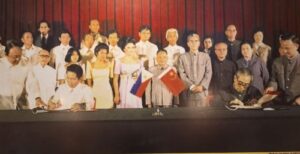
Taiwan as an integral part of China.
Resolution 2758 was adopted by the UNGA with 76 member states voting in favor of China, 35 against and 17 abstentions.
The Philippine’s recognition of Taiwan being a part of China is also embodied in the ‘Joint Communique’ that formally established diplomatic relations between the two countries 50 years ago, on June 9, 1975.
Signatory to that commitment is the President’s father, Ferdinand Marcos Senior, with his family among the witnesses, including the young Marcos Jr.
Since then, Taiwan and the Philippines officially have no formal diplomatic relations, but each maintain an ‘Economic and Cultural Office.’
In January last year, President Marcos continues to insist that the Philippines remain committed to the One China Policy, saying:
“The One China policy remains in place. We have adhered to the One China policy strictly and conscientiously since we adopted the One China policy. That has not changed, that will not change. We do not endorse Taiwan’s independence.”
Marcos made the remark after being criticized by Beijing for congratulating Taiwan’s fake president, Lai Ching-te, in winning the election.
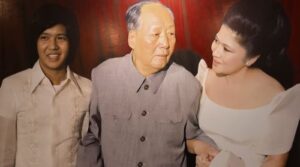
The United States, for its part, also finally recognized the One China Policy thru the ‘Joint Communique’ they signed on December 15, 1978, followed by the formal establishment of their diplomatic relations days later, on January 1, 1979, some seven years after President Richard Nixon’s historic visit to China in February 1972.
Despite this, however, the United States continue to play a double game against China by impliedly giving Taiwan recognition thru massive economic and military support to this day.
The United States’ determination to use the ‘Taiwan Card’ against China is evident as far back as the start of Korean War in 1950. When war broke out, the first act of US President Harry Truman is to order a blockade of the Taiwan Strait to prevent an imagined Chinese invasion.
‘Refrain from playing with fire’
President Marcos Jr.’s change of policy from neutrality to belligerency immediately drew sharp criticism and warning from Beijing.
At a press briefing last August 8, the day he arrived back from his visit to India, China’s Foreign Ministry reminded that “there is but one China in the world. Taiwan is an inalienable part of China.
“The Taiwan question is China’s internal affair which is at the very core of China’s core interests. How to settle it is a matter for the Chinese ourselves, which brooks no interference.”
China has repeatedly warned it considers the ‘Taiwan Question’ a ‘Red Line’ that nobody should cross.
China also repeatedly warned that it is ready to use force and invade Taiwan if the United States and its vassals, including the Philippines, succeeded in goading separatist elements there to declare independence.
After reminding Marcos of the Philippines’ commitment to the One China Policy, the MFA noted that “the Philippines is going back on its words in disregard of the grave consequences.”
“It needs to be further stressed that ‘geographic location’ and ‘large volume of Filipinos’ in Taiwan should not be used as pretexts to interfere in the internal and sovereign affairs of other countries.
“These claims not only contravene international law and the ASEAN Charter but also harm regional peace and stability and the fundamental interests of its own people. We urge the Philippines to earnestly abide by the one-China principle and the spirit of China-Philippines Joint Communiqué on the establishment of diplomatic relations, and refrain from playing fire on issues bearing on China’s core interests.”

Comments are closed.