

Get rid of ‘human viruses’ at the DICT, Secretary Aguda
IN 2016, the United Nations General Assembly (UNGA) approved a resolution amending Article 19 of the Universal Declaration of Human Rights (UDHR), stating that access to the Internet is now one of humanity’s “basic human right.”
In May of the same year, RA 10844, the law that created the Department of Information and Communications Technology (DICT) was passed where part of its ongoing mandate is the operationalization of the government’s ‘Free WiFi Project for All.’
Despite still being a “young” organization, the DICT was immediately involved in controversies.
In 2021, just two years in existence and the year the Free WiFi Project was rolled out, the DICT was hit with a controversy over the alleged “tongpats” (overprice) in the budget for its implementation.
The same issue reappeared during the hearing last October 22 at the Senate where Senator Loren Legarda questioned Secretary Henry Rhoel Aguda on the “four times increased” in the monthly subscription for the Free WiFi Project paid to Telcos in her province of Antique:
From P26,000 a month as stated by Aguda to over P96,000 as quoted by Legarda, from a dubious, unsigned document she received purportedly coming from the DICT Central Office.
Having been confirmed by the Commission on Appointments only last October 1, it would be unfair to blame Secretary Aguda for the shenanigans happening at the DICT.
Secretary Aguda came from the private sector where things are run very differently before agreeing to take on the DICT portfolio. Hopefully, what he been uncovering so far does not affect his faith in government’s sincerity to serve the public.
And the Systems Man that he is, Secretary Aguda managed to identify where the rot of corruption at the DICT is coming:
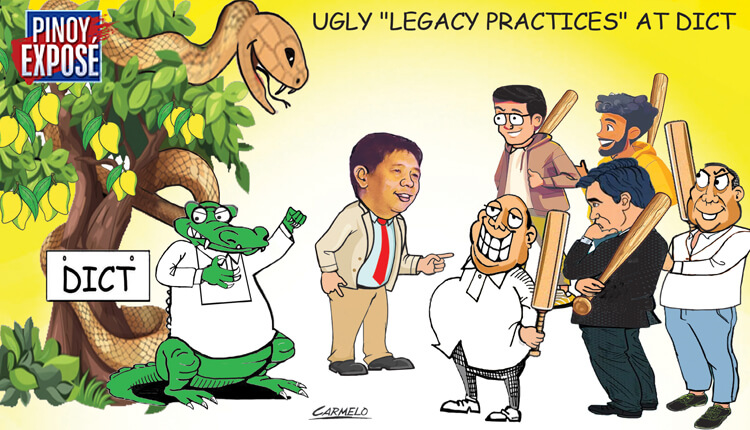
From the “legacy practices” (“nakagawian” or “nakasanayan” in local parlance) that he inherited from his six predecessors.
Now, these practices may not necessarily be moral and legal, Heck, some of them could have been questionable, criminal, or both.
Let us be real: Appointees to all government posts do not necessarily have the public’s best interest in mind.
Many wants to get appointed so they can exploit the power and authority given to them by law to advance their pecuniary interest—for as long as they do not displease their “backers” in the higher corridors of power.
This is the situation that now confronts Secretary Aguda—earnest to obey the President’s good governance mandate, he finds his reform agenda being sabotaged by those within his own department who never considers him their “boss” to begin with. Why would they when they, too, are presidential appointees?
And the bum steer to Sen. Legarda was not the first effort to undermine him.
During his confirmation hearing last October 1, a “White Paper” was circulated at the Senate against him and his Chief of Staff that is clearly meant to influence the Commission on Appointments to reject his appointment.
If Secretary Aguda is determined to succeed, our “friendly” tip is that he should
have a total “reset” of the DICT to make corruption “obsolete.”
He should start with the basic fixes: people, practices, and processes, if he wants to deliver on the President’s expectations.
Unless he gets rid of the “human viruses” who have been exploiting the DICT’s vulnerabilities for their own end– and at his expense– he won’t get very far.
Abangan!

Comments are closed.