

China cautions PH officials between “friendship and confrontation”
'Blatant provocations’ designed to undermine relations
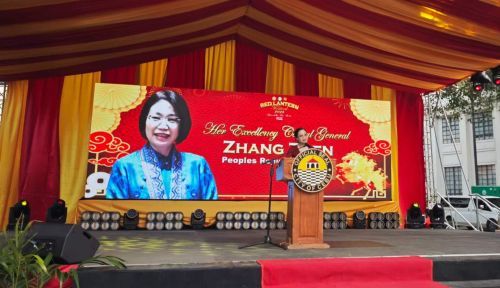
Cebu City– A RANKING official at the Chinese Embassy warned that continuing efforts by some Philippine officials to undermine the relationship of both countries may soon result to a choice between “friendship and confrontation.”
Speaking at a media forum in Cebu City, Chinese Consul General in Cebu, Madame Zhang Zhen, warned that Cebu City’s decision to commemorate every July 12 as ‘West Philippine Sea (WPS) Victory Day’ and its invitation to Defense Secretary Gilberto ‘Gibo’ Teodoro Jr. during the event could undermine relations between Cebu and China, describing the move as a “blatant provocation.”
Zhang said both gestures sent an unfavorable message to Beijing,” Zhang warned.
“As the Chinese Consul General based in Cebu, I really did not expect such a blatant provocation,” Zhang said.
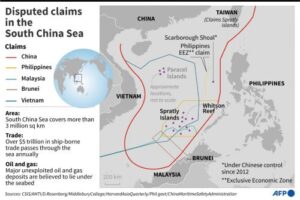
On July 12, 2016, the non-governmental Permanent Court of Arbitration (PCA) based in The Hague, issued its opinion (‘Award’) on the request for arbitration filed by the Philippines against China in 2012 over their disputing claims in some parts of the South China Sea.
(While the ruling invalidated China’s so-called ‘9 dash lines’ to designate the areas it is claiming as part of its national territory and affirmed the Philippines’ sovereign rights thru its exclusive economic zones (EEZ), it did not rule on the main issue of territoriality as this is not covered by UNCLOS nor was it specifically raised by the Philippines– see related article here).
Zhang added that Cebu’s actions raise the question of whether the city chooses “friendship or confrontation,” urging local leaders to pursue exchanges and cooperation instead of actions that could damage bilateral ties.
China has since lodged a diplomatic protest through its Consulate in Cebu over the city’s resolution commemorating the arbitral ruling.
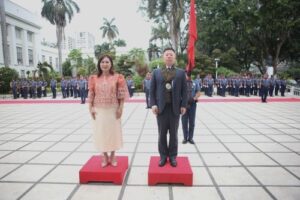
Zhang reiterated Beijing’s position that it does not recognize the 2016 Arbitral Award, describing the proceedings as politically motivated and lacking jurisdiction.
She argued that the dispute concerns territorial sovereignty, which China maintains is outside the scope of the United Nations Convention on the Law of the Sea (UNCLOS). According to Zhang, China had already excluded maritime delimitation disputes from compulsory arbitration under its 2006 declaration pursuant to Article 298 of UNCLOS, making the tribunal’s ruling “illegal, null and void” from Beijing’s perspective.
The Chinese envoy further cautioned that Cebu’s recent actions could have short- and long-term diplomatic and economic consequences, noting the province’s long-standing historical, cultural, and commercial ties with China, including Cebu City’s sister-city relationship with Xiamen.
She said Cebu has become a favored destination for Chinese visitors because of its openness and cultural diversity, adding that local officials’ actions could have “direct or indirect” impacts on bilateral relations.
Zhang also reiterated China’s sanctions against Defense Secretary Teodoro, accusing him of repeatedly making what Beijing considers groundless attacks against China.
Undermining diplomatic initiatives
The diplomatic tensions stand in contrast to recent initiatives aimed at strengthening bilateral cooperation. On March 29, 2026, Xiamen Airlines resumed direct flights between Cebu and Jinjiang (Quanzhou), Fujian Province, restoring a key air link that operates twice weekly, every Tuesday and Saturday, via Quanzhou Jinjiang International Airport.
The route is expected to boost tourism, trade, investment, and people-to-people exchanges between Central Visayas and southeastern China.
The route was first announced by Chinese Ambassador to the Philippines Jing Quan, who said it was approved in response to requests from Cebu residents.
He noted that “90 percent of Filipino-Chinese are from Fujian” and said the new service would allow more Chinese visitors to travel directly to Cebu while maximizing the Philippines’ visa-free arrangements and accelerating the recovery of inbound tourism.
Jing described the new route as an important step toward strengthening exchanges between the two countries.
President Ferdinand Marcos Jr. welcomed the reopening of the Fujian–Cebu route, thanking Ambassador Jing for the initiative and expressing hope that it would become “the beginning of more interactions and people-to-people exchange between China and the Philippines.”
The President said stronger connectivity would contribute to closer bilateral relations and greater cooperation.
At the inaugural flight ceremony, Cebu Governor Pamela Baricuatro underscored that the restored route is about more than tourism.
She said it aims to strengthen cultural understanding, economic cooperation, business opportunities, and community partnerships, describing Cebu as “a gateway” at the crossroads of culture and commerce.
In a separate commentary titled “Friendship or Confrontation,” Herman Tiu Laurel, founder and president of the Asian Century Philippines Strategic Studies Institute (ACPSSI), argued that the Cebu City Council’s actions contradict both provincial and national efforts to rebuild ties with China through tourism and economic engagement.
Laurel noted that Governor Baricuatro had earlier welcomed stronger cooperation with Chinese officials and supported the reopening of the Cebu–Jinjiang route to promote tourism and investment.
Laurel said the Philippines received a record 1.9 million Chinese tourists in 2019, generating an estimated US$2.5 billion in tourism receipts and supporting about six million Filipino workers and entrepreneurs.
However, he noted that arrivals fell to 262,144 in 2025 despite government efforts to revive the market through visa facilitation. He warned that actions perceived by Beijing as provocative could undermine tourism recovery and economic growth, particularly at a time when neighboring countries continue to attract significantly larger numbers of Chinese visitors.
While Zhang and Laurel emphasized the value of maintaining stable relations with China, Cebu City officials have maintained that the observance of West Philippine Sea Victory Day is intended to uphold international law and Philippine sovereignty, not to provoke conflict.
The Philippine government likewise continues to recognize the 2016 Arbitral Award as final and legally binding under international law, a position that remains at odds with Beijing’s rejection of the ruling (contributed article from Ms. Cathy Cruz).

Comments are closed.