

BOC inks agreements with AFP, Israel Customs
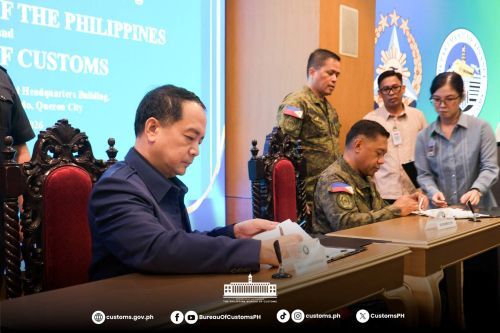
THE Bureau of Customs under Commissioner Ariel F. Nepomuceno signed a memorandum of agreement (MOU) with the Armed Forces of the Philippines (AFP) to combat smuggling and strengthen the country’s border security.
The signing ceremony was held last July 15 between Commissioner Nepomuceno and AFP Chief General Romeo Brawner, in one of his official acts before stepping down from military service on July 21.
The anti-smuggling partnership between the BOC and the AFP has a long history, dating back to the time of President Diosdado Macapagal, when he appointed Cesar Climaco as Customs Commissioner in 1961. Among Climaco’s first acts was to bring in graduates of the Philippine Military Academy (PMA) to help him manage the agency in curbing corruption.
Under Nepomuceno, the AFP not only assisted in the fight against smuggling but also in training the bureau’s newest elite enforcement unit, the Customs Police Rapid Intervention Group (Pinoy Exposé, May 12 and May 13, 2026).
The present BOC-AFP MOU formalizes the framework for cooperation to ensure lawful, secure, and accountable coordination between the two agencies.
The agreement covers information sharing, capacity building, operational support, and legal cooperation on matters involving border security, customs enforcement, national security, and revenue protection, while recognizing the BOC’s primary authority and defining the AFP’s role as a supporting agency.
Key to its success is the establishment of a ‘Joint Coordination Committee’ (JCC) to serve as the primary policy and oversight body for the implementation of the MOU.
The JCC is tasked to establish secure coordination channels, approval of priority information requirements and coordination procedures, among other functions.
The MOU also envisions to create a Joint Trade-Security Validation Cells (JTSVCs) to support the analysis, validation, and coordination of intelligence and security information related to smuggling, strategic goods diversion, foreign-linked entities, and other trade-security threats.
Commissioner Nepomuceno emphasized that the partnership reinforces the government’s commitment to safeguarding the country’s borders through stronger inter-agency cooperation.
“Smuggling is not only an economic crime—it is also a national security concern. This partnership with the Armed Forces of the Philippines strengthens our ability to protect our borders, disrupt smuggling networks, and safeguard government revenue.
“Mas matibay ang laban natin kapag sama-sama ang mga ahensya ng pamahalaan. Together, we will uphold the law with integrity and decisive action,” he explained.
For his part, the outgoing AFP Chief said he welcomes the partnership as a testament to the government’s unified commitment to safeguarding national security, protecting legitimate trade, and advancing the country’s broader economic interests.
BOC, Israel Customs ink ‘Mutual Recognition Agreement’
Two days previously, on July 13, the BOC and the Israel Customs Directorate signed a ‘Joint Action Plan’ marking the official start of their cooperation towards establishing an Authorized Economic Operator (AEO) Mutual Recognition Arrangement (MRA) between the Philippines and Israel.
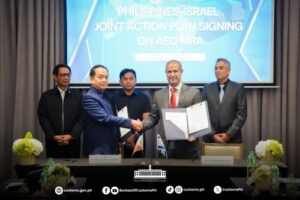
The JAP was signed by Commissioner Nepomuceno and Israel Customs Directorate Director General Kfir Hen.
It serves as the ‘roadmap’ for both Customs administrations in negotiating and implementing the AEO MRA, outlining the activities, timelines, and responsibilities that will guide both sides throughout the process.
Under the arrangement, both countries will undertake technical assessments, validation visits, and information exchanges before negotiating and finalizing the MRA.
Once in place, the agreement will enable both Customs administrations to mutually recognize each other’s AEO programme, allowing accredited traders to enjoy enhanced trade facilitation benefits.
The partnership is expected to benefit the Philippines by facilitating faster and more efficient customs clearance for qualified exporters and importers, reducing unnecessary inspections, strengthening supply chain security, and promoting greater trade and investment between the Philippines and Israel.
It also reinforces the country’s commitment to internationally recognized customs standards and supports President Ferdinand R. Marcos Jr.’s directive to modernize government services, strengthen the country’s competitiveness, and improve the ease of doing business through more efficient and secure trade facilitation.

Comments are closed.